 VI
VI EN
EN JP
JP“Made in Vietnam” social media explosion: A neverending race?
The race of domestic social media to approach the potential user market in Vietnam is on fire like never before.
According to statistics, Vietnam ranks 7th in the top 10 countries with the most Facebook users in the world. Their gigantic demand and interest bring issues on data security. Especially when recently, Ministry of Information and Communications sends out continuous warnings on information security, as well as Facebook's inadquate compliance to Vietnam's law, people say that it is time we should develop our own social media.
According to ICTNews: “Reality shows that not every countries use Facebook for 100%. Many countries have their own social media, like QQ or WeChat in China, Kakaotalk in Korea, VK (VKontakte) in Russia. Thus, it is understandable if Vietnam wishes to build their own social media".
For this reason, many businesses have nurtured ideas for Vietnamese' own social media, quite many of them have been released to the public.
1. Zalo
In Vietnam, Zalo is a widely known domestic social media apart from Facebook and YouTube, with about 40 million users. This number reflects a positive result, up to half of all Vietnamese uses Zalo, almost 70% of Facebook users. Statistics of Ministry of Information and Communications point out that on an average day each Vietnamese spends 3.55 hours for Facebook, and it is 2.21 hours for Zalo - not much of a difference.
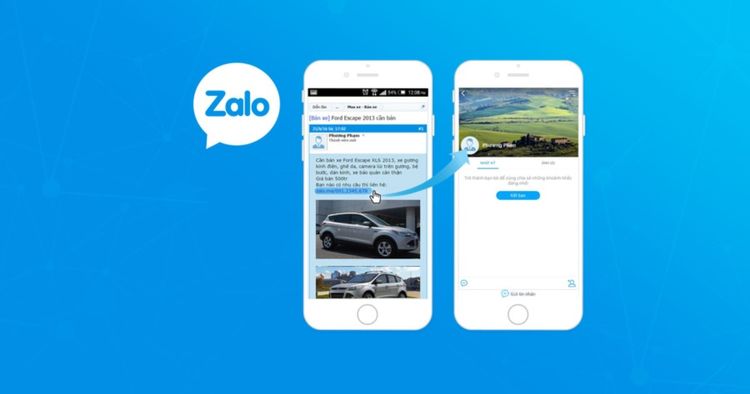
Clearly Facebook has more features, so considering using trend, Facebook Messenger is more common among user community, especially among friends for its coverage. Meanwhile, Zalo dominates in personal exchanges and dating. Besides, this “made in Vietnam” application is favored by quite many for its effective image transfering, with original quality retained and fast transfer speed.
It could be said that the release and fast pace innovations of Zalo can prove that we can totally be optimistic in the competition between domestic social media market and big international names.
2. Hahalolo
At the beginning of 2018, we welcomed an ear-catching name “Hahalolo” - self proclaimed as the first travel social media developed by Vietnamese. It is easy to see that just like Facebook, Twitter, Instagram, YouTube,... Hahalolo features friend connections, conversations, information sharings... But this app has one advantage that can act as a premise to replace other social media in Vietnam market. The official website of Hahalolo says: “Within only one platform of Hahalolo, users can simultaneously book hotels, tours, plane tickers, do their shopping, share travel experiences and connect with friends".
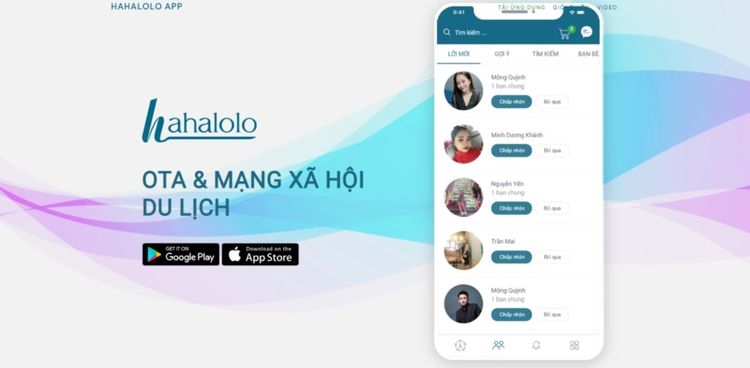
All questions regarding traveling will be solved by the app. The project is created by a young startup in Vietnam. Hahalolo.com has released a trial version, and is well-received with positive feedbacks. However, after one year in operation, the name is off the heat, so let's look forward to Hahalolo's next steps in the future.
3. Biztime
Widely promoted as "highly competitive rival to Facebook" - Biztime made its first appearance in August 2018, and is currently in polishing. Due to similar features and appearances as Facebook, Bizteam has been viewed as a copy of this "national social media".

Looking at the interface, many users said that this application is "copying" Facebook with similarity rate of up to 90%. However, CEO of Biztime said: "With this interface, users will not be too unfamiliar when moving from Facebook to Biztime.”.
The young CEO also shares his excitement about his goals to build an ecosystem with all the features like information sharing, e-commerce, online trading... along with messaging applications, e-wallet... in both website and mobile app. Not just limited in domestic market, aiming at reaching out to the world, with South East Asia as the first destination, BizTime is updating more languages. However, this app's system as well as running speed are yet to be optimized, so the operation is not as smooth as expected.
4. Gapo
On July 23rd, social media Gapo by Gapo Techonolgy JSC. (a part of G-Group of chairman Phung Anh Tuan) made its official release with a goal of reaching 50 million users in 2021.
Built from April 2019, this app is expected by the developers to stand out among domestic social media.
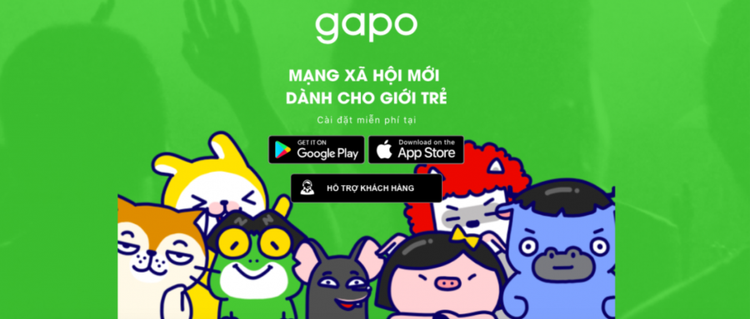
With all the basic features like posting texts, images, videos, making friends, talking online...Gapo has a burning desire to focus on live streamming and blogging.
To solve non-optimal security and identification issues of Facebook, G-Group app requires users to identify their accounts via personal identifications. By promoting serious registrations, Gapo is willing to share revenue with verified users in the future.
Right after release, this social media received many surprising reactions like not being able to log in, sign up, make posts... After considerations and adjustments, in the evening of July 24, Gapo called for an operation halt to upgrade and fix bugs. The application has yet to make any comeback announcement.
5. Lotus
At the beginning of August 2019, a “made in Vietnam” social media was established, invested and deployed by VCCorp, rumbling up the media. Released under the name of Vietnam's international flower, Lotus is new social media with lots of expectation form the community.
Lotus moves towards creating a difference by being content-focused, as shared by the company in charge: “Lotus creates a platform that supports content creators and individuals in their freedom of creation for better quality content for users. Lotus also uses AI to select, "track" violated content like: counterfeit sellers, multi-level marketing, scams, fake news... or if users post a wrong map, Lotus also has algorithms for timely detection and resolution."
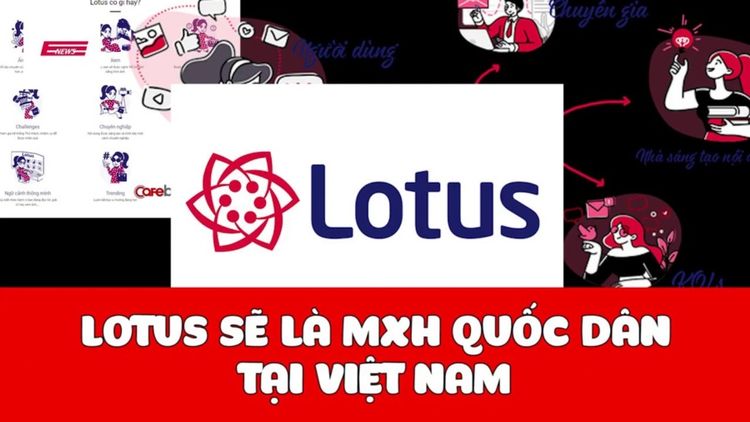
Especially, using the appeal of earning virtual currency by sharing useful content, Lotus attracts young people when introducing token - real earnings on virtual world. Users do not only get to share new information and experiences, they also got to participate in challenges and missions to receive gifts. This is quite of a new direction to spread wholesome and useful values.
With a giant team - more than 200 engineers in mobile application like AI, Big Data, Cloud Computing,...VCCorp is confident with this app becoming a new star among domestic social media after its official beta release in mid Spetember this year. This ambition is clearly demonstrated in their announcement: “VCCorp hopes that Lotus will reach 4 million users/day, which is a very meaningful landmark because technical disadvantages will start to appear at that point, from then new pathways for development will be formed.”
With an enormous funding of 700 billion dong raised from self-financing and domestic investors, VCCorp plans to raise 500 billion dong more for its initial stage to prepare for long-term development.
Conclusion
In the age of non-stop developing digitization in Vietnam where user market shows more and more gigantic potentials, the births of more domestic social media might become a neverending race.
Putting aside inadequacies like incomplete features that need more than just a day or two, it can be clearly seen that “made in Vietnam” names on a streak of creativity to build social media with markings of our own intelligence are worth encouraging.
It cannot be denied that Vietnamese put in much positive effort in improving data security with international brands exploiting at their own will. On the other hand, this highly competitive race forces the brand to continuously develop, improve and optimize their functions, promoting user's benefits.
In reality, many people are still critical of Vietnamese social media, disapproving of service quality, system speed, friendliness of interface... However, we have the rights to be proud and positive of a bright future with the blooming of “made in Vietnam” social media, because whether they succeed or not, these are remarkable achievements to social development that assert Vietnamese intelligence's position in the global tech map.





 LOGIN WITH G-SUITE ACCOUNT